Keyword stuffing was an SEO tactic that worked in 2005. Today, it's a guaranteed way to hurt your rankings. But you still need to include keywords—the question is how much is too much? And how do you know if your content is optimized or over-optimized?
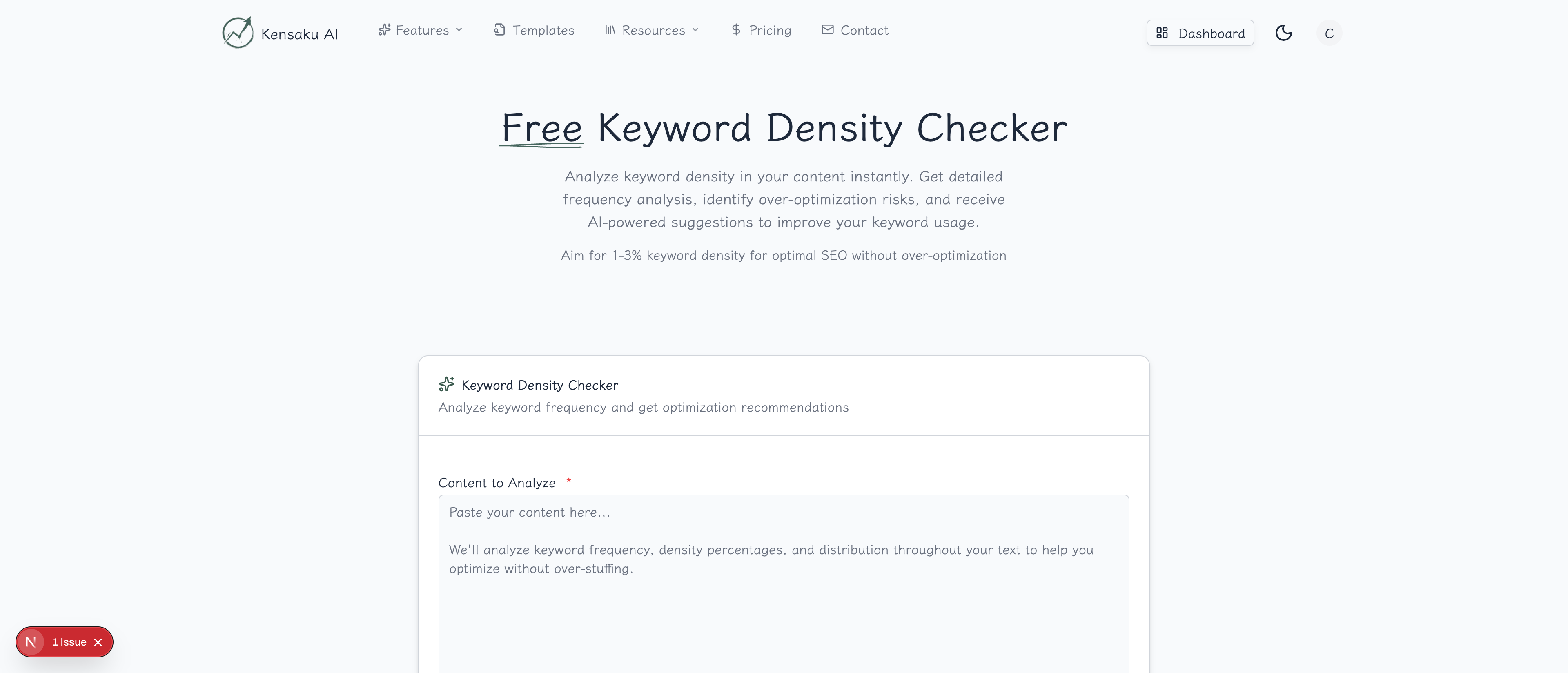
Our free Keyword Density Checker analyzes your content to ensure your keyword usage is balanced, natural, and effective for modern SEO.
What is Keyword Density?
Keyword density is the percentage of times a keyword appears compared to the total word count of a page. It's calculated as:
Keyword Density = (Number of keyword occurrences / Total words) × 100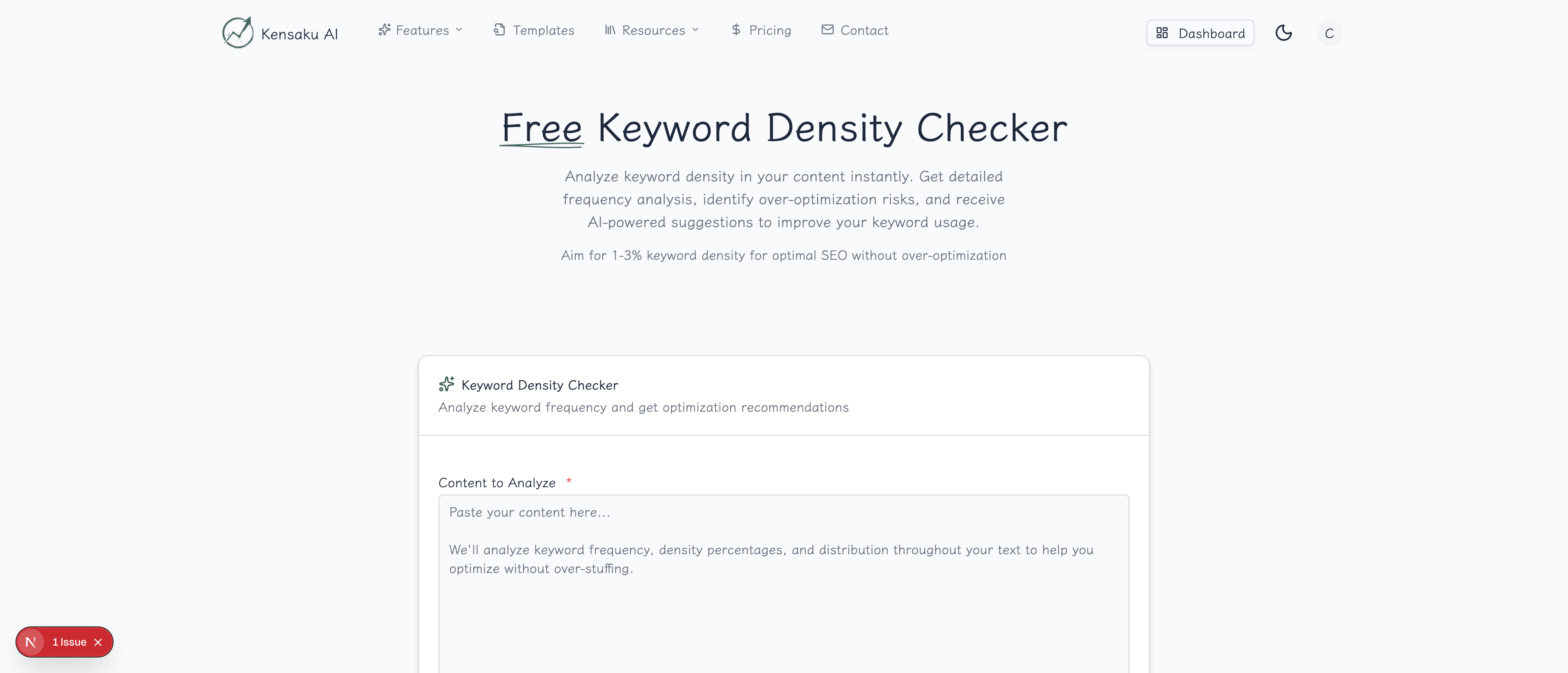
For example, if your target keyword appears 15 times in a 1,500-word article, your keyword density is 1%.
Why Keyword Density Still Matters
Avoiding Over-Optimization
Google's algorithms detect keyword stuffing and penalize it:
| Keyword Density | Risk Level |
|---|---|
| Under 0.5% | May be under-optimized |
| 0.5% - 1.5% | Optimal range |
| 1.5% - 2.5% | Use with caution |
| Over 2.5% | High risk of penalty |
Finding the Balance
Your content needs enough keyword presence to signal relevance without:
- Sounding unnatural
- Triggering spam filters
- Creating poor user experience
- Being penalized by algorithms
Quality Signal
Natural keyword usage indicates:
- Topical relevance
- Quality writing
- User-focused content
- Expertise on the subject
How the Checker Works
Step 1: Enter Your Content
Paste the full text of your page, article, or landing page. The tool works best with:
- Complete content (not just snippets)
- At least 300 words for accurate analysis
- Final or near-final drafts
Step 2: Specify Target Keywords
Enter the keywords you want to analyze:
- Primary keyword: Your main target term
- Secondary keywords: Related terms and variations
- LSI keywords: Semantically related phrases
Step 3: Analyze Results
The checker provides:
Overall Metrics:
- Total word count
- Unique word count
- Average sentence length
- Reading level
Per-Keyword Analysis:
- Exact match count
- Keyword density percentage
- Recommendation (increase/decrease/optimal)
- Placement analysis (title, headings, body)
N-gram Analysis:
- Most common 2-word phrases
- Most common 3-word phrases
- Identifies unintentional repetition
Step 4: Optimize
Use the insights to adjust your content:
- Add keywords if under-optimized
- Remove or vary keywords if over-optimized
- Check keyword placement across the page
- Ensure natural flow
Understanding the Results
Density Scores
| Score | Interpretation | Action |
|---|---|---|
| 0-0.5% | Under-optimized | Add more natural mentions |
| 0.5-1% | Good | May be optimal for high-competition |
| 1-1.5% | Optimal | Ideal for most content |
| 1.5-2% | Borderline | Review for naturalness |
| 2%+ | Over-optimized | Reduce keyword usage |
Placement Quality
Keywords should appear in:
- Title tag (high importance)
- First 100 words (high importance)
- H1 heading (high importance)
- H2 subheadings (medium importance)
- Body content (distributed naturally)
- Last paragraph (medium importance)
Keyword Variations
Don't just repeat the exact keyword. Use:
- Plural/singular variations
- Synonyms
- Related terms
- Long-tail variations
- Natural language phrases
Keyword Density Best Practices
Focus on Natural Writing
Write for humans first, then optimize:
Stuffed (bad): "Our SEO tools help with SEO. The SEO software provides SEO analysis for better SEO results. Use our SEO platform for SEO."
Natural (good): "Our platform helps improve your search rankings. The analysis tools identify optimization opportunities, while the software automates tedious SEO tasks."
Use Semantic Variations
Google understands synonyms and related concepts:
| Primary Keyword | Variations |
|---|---|
| SEO tools | search optimization software, ranking tools, SEO platform |
| keyword research | finding keywords, keyword discovery, search term analysis |
| content marketing | blog strategy, content strategy, publishing |
Consider TF-IDF
Beyond simple density, consider Term Frequency-Inverse Document Frequency:
- How often competitors use the term
- Whether the term is unique to your topic
- Related terms that ranking pages include
Match Content Type
Different content types have different density norms:
| Content Type | Typical Density |
|---|---|
| Blog posts | 1-1.5% |
| Product pages | 1-2% |
| Landing pages | 1.5-2% |
| Category pages | 0.5-1% |
| News articles | 0.5-1% |
Common Keyword Density Mistakes
Obsessing Over Exact Numbers
Problem: Targeting exactly 1.47% density Reality: There's no magic number Fix: Aim for a range, prioritize naturalness
Ignoring Keyword Placement
Problem: Keywords only in body text Impact: Missing high-value positions Fix: Include in title, headings, first paragraph
Forgetting Variations
Problem: Only using exact-match keyword Impact: Unnatural, misses related searches Fix: Use synonyms, related terms, variations
Keyword Stuffing in Headers
Problem: "SEO Tips: SEO Strategies for SEO Success" Impact: Obvious manipulation, poor UX Fix: One keyword per heading, naturally phrased
Invisible Keyword Stuffing
Problem: White text on white background, hidden text Impact: Manual penalty, deindexing Fix: Never hide text—it's black-hat SEO
Keyword Density for Programmatic SEO
Template Optimization
For programmatic SEO pages, optimize your templates:
Template analysis:
- Fixed text: 500 words, "SEO" appears 3 times = 0.6% density
- Variable text: 200 words average
- Total: 700 words

Ensure combined density stays optimal across all variations
Scaling Quality Control
For thousands of pages:
- Set density thresholds in your pipeline
- Flag pages outside optimal range
- Sample and review regularly
- Adjust templates based on performance
Variable Impact
Consider how variables affect density:
Template: "Best [product] for [industry]"

If [product] = "CRM software" and content mentions CRM 10 times:
- Short industry names = higher density
- Long industry names = lower density
Avoiding Duplicate Patterns
When scaling, watch for:
- Same keyword patterns across pages
- Repetitive phrase structures
- Template text becoming recognizable
Advanced Density Analysis
N-gram Analysis
Look beyond single keywords:
2-grams (two-word phrases):
- "content marketing" appears 8 times
- "SEO strategy" appears 6 times
3-grams (three-word phrases):
- "search engine optimization" appears 4 times
- "programmatic SEO tools" appears 3 times
Competitor Benchmarking
Compare your density to ranking pages:
- Identify top 10 ranking pages
- Analyze their keyword density
- Note common ranges
- Optimize to compete
Contextual Analysis
Consider where keywords appear:
- Clustered vs. distributed
- Natural flow vs. forced insertion
- Supporting context around keywords
Measuring Density Impact
Before/After Testing
When adjusting keyword density:
- Record baseline rankings and traffic
- Make density changes
- Wait 2-4 weeks
- Compare performance
Correlation Analysis
Track across multiple pages:
- Does higher density correlate with rankings?
- What density range performs best?
- Are there content-type differences?
Warning Signs
If after increasing density you see:
- Rankings drop
- Traffic decreases
- Bounce rate increases
You may have over-optimized. Pull back immediately.
Keyword Density vs. Modern SEO
It's One Factor Among Many
Keyword density matters, but so does:
- Content quality and depth
- User engagement metrics
- Backlink profile
- Technical SEO
- E-E-A-T signals
Semantic SEO Is King
Google understands topics, not just keywords:
- Cover the topic comprehensively
- Answer related questions
- Use natural language
- Include supporting concepts
Focus on User Intent
The best optimization:
- Answers the user's question
- Provides value
- Keeps readers engaged
- Earns shares and links
Integration with Content Workflow
Build density checking into your process:
- Content Brief → Define target keywords
- Write content → Focus on quality first
- Keyword Density Checker → Analyze optimization
- Readability Checker → Verify natural flow
- Adjust → Fine-tune keyword usage
- Publish → Monitor performance
Get Started
Ready to find the perfect keyword balance for your content? Try our free Keyword Density Checker now.
For teams creating content at scale, explore our full platform with automated content analysis and optimization across thousands of programmatic SEO pages.