The secret to successful programmatic SEO isn't just finding keywords—it's finding patterns. When you discover that "plumber in Austin" follows the same structure as "plumber in Dallas" and "plumber in Houston", you've unlocked the potential to create hundreds of targeted pages from a single template.
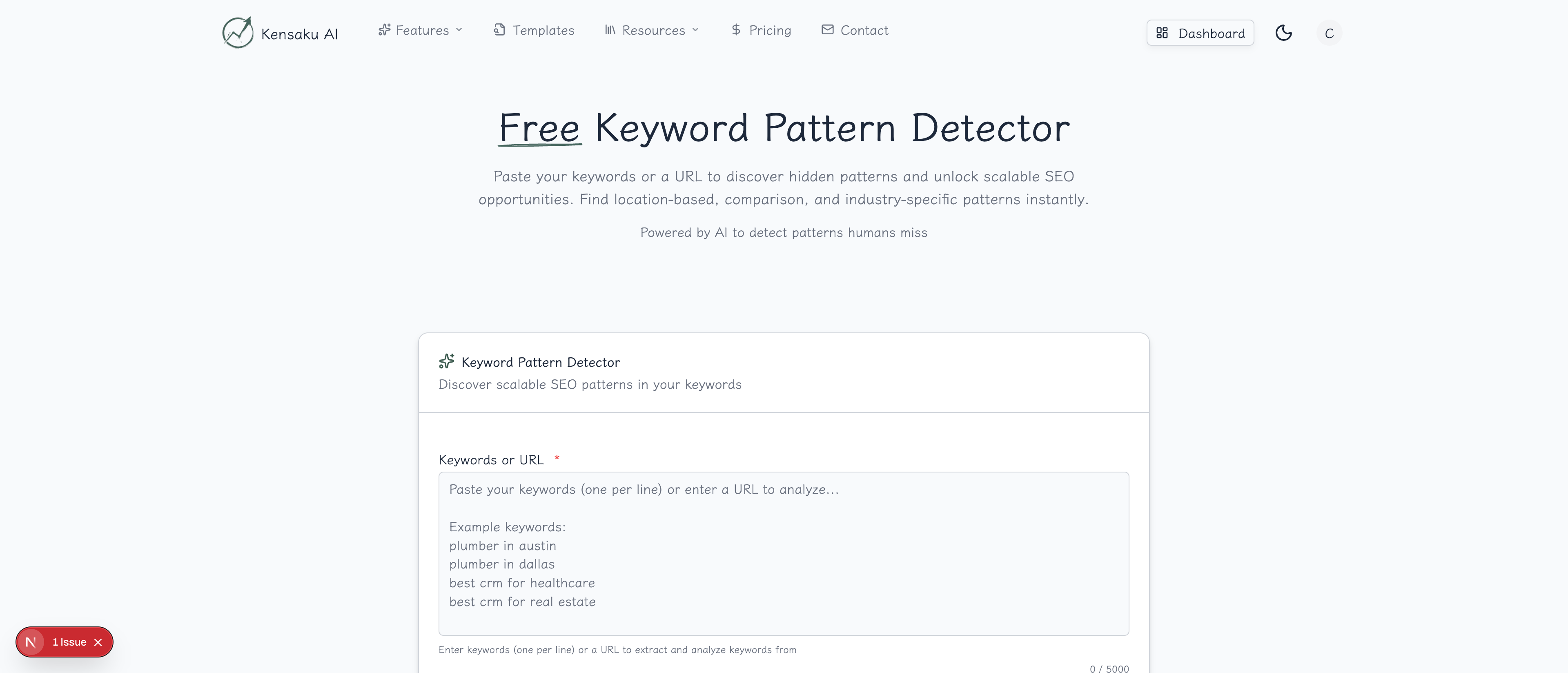
Our free Keyword Pattern Detector uses AI to analyze your keyword lists and identify these scalable patterns automatically.
What is Pattern Detection?
Pattern detection is the process of identifying repeatable structures in your keywords that can be templated and scaled. Instead of creating content one page at a time, you find formulas that work and apply them across multiple variations.
Types of Patterns the Tool Detects
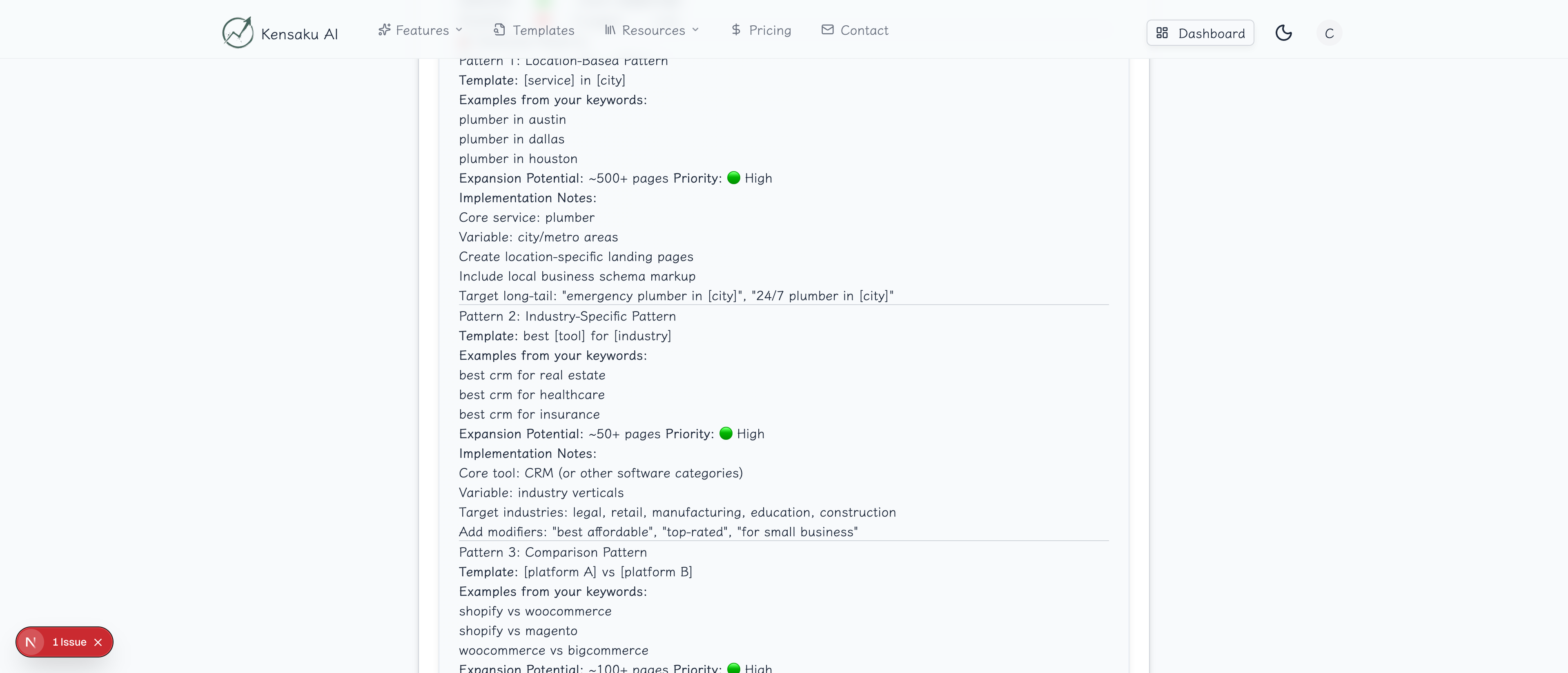
Location-Based Patterns
The most common and often most valuable pattern type. Examples:
[service] in [city]→ plumber in Austin, plumber in Dallas[city] [service]→ Austin plumbers, Dallas plumbersbest [service] near [location]→ best dentist near downtown
Expansion potential: 500+ pages (covering all major cities)
Industry/Vertical Patterns
Target specific niches with tailored content:
best [tool] for [industry]→ best CRM for real estate, best CRM for healthcare[industry] [solution]→ healthcare CRM, real estate CRM[tool] for [business type]→ invoicing for freelancers, invoicing for agencies
Expansion potential: 50-100+ pages (covering all relevant industries)
Comparison Patterns
High-intent keywords where users are actively evaluating options:
[product A] vs [product B]→ Shopify vs WooCommerce[product] alternatives→ Shopify alternatives[product A] or [product B]→ Slack or Teams
Expansion potential: 100+ pages (all possible combinations)
Question-Based Patterns
Informational queries that drive top-of-funnel traffic:
how to [action]→ how to start a blog, how to start a podcastwhat is [concept]→ what is programmatic SEOwhy [topic]→ why use a CRM
Expansion potential: 1000+ pages (endless variations)
How to Use the Pattern Detector
Step 1: Gather Your Keywords
Before using the tool, compile a list of keywords. Good sources include:
- Your existing Google Search Console data
- Competitor keyword analysis
- Keyword research tool outputs
- Customer questions and support tickets
The more keywords you provide, the more patterns the AI can detect.
Step 2: Paste or Enter a URL
You can either:
- Paste keywords directly (one per line)
- Enter a URL to extract and analyze keywords from a page
Step 3: Select Analysis Depth
Choose your analysis level:
- Quick Scan: Fast overview of major patterns
- Detailed Analysis: Comprehensive pattern detection with examples
- Comprehensive Report: Maximum insights with implementation recommendations
Step 4: Review the Results
The tool returns a structured analysis including:
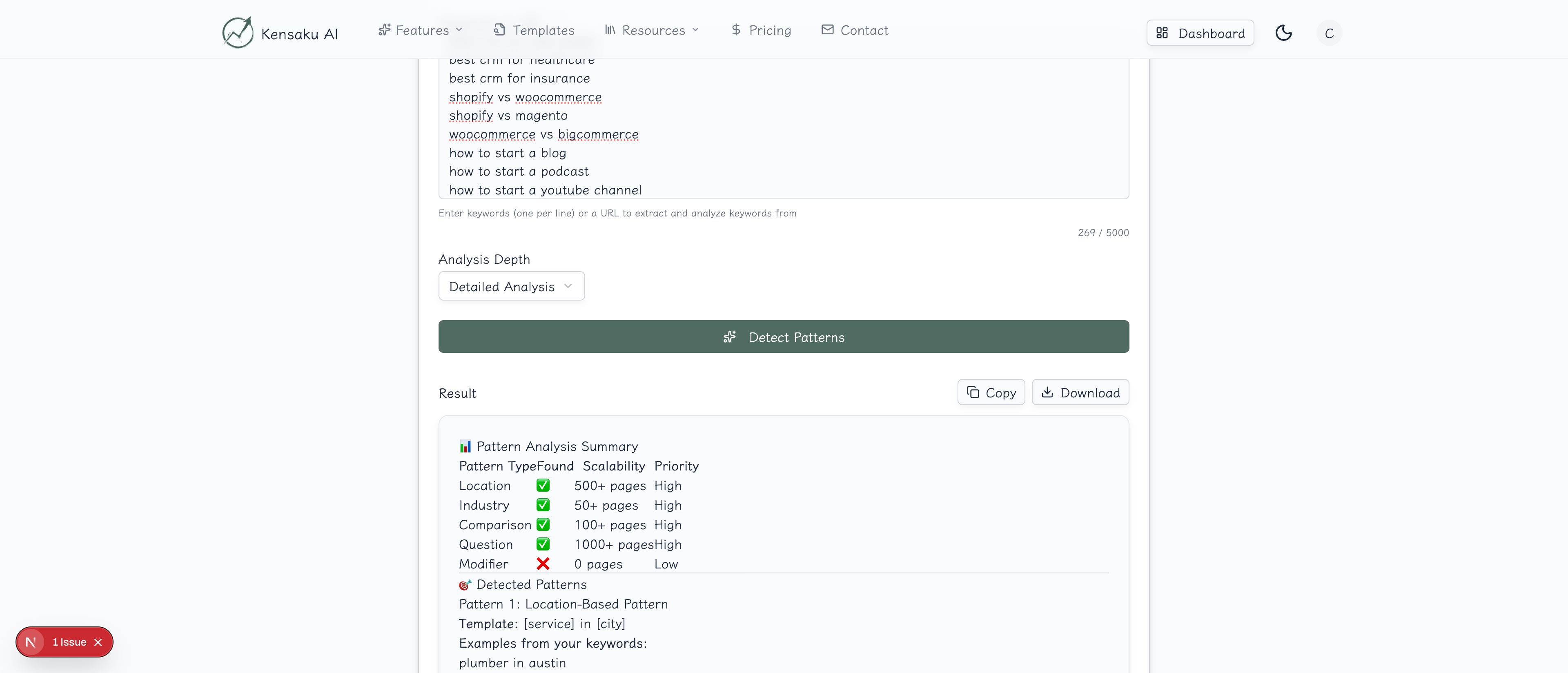
Pattern Summary Table: Overview of all detected patterns with scalability estimates and priority levels.
Detected Patterns: Detailed breakdown of each pattern including:
- Template structure
- Examples from your keywords
- Expansion potential
- Implementation notes
Recommended Actions: Prioritized next steps based on your patterns.
Ready-to-Use Templates: URL structures, title templates, and content guidelines for each pattern.
Real Example: Analyzing Mixed Keywords
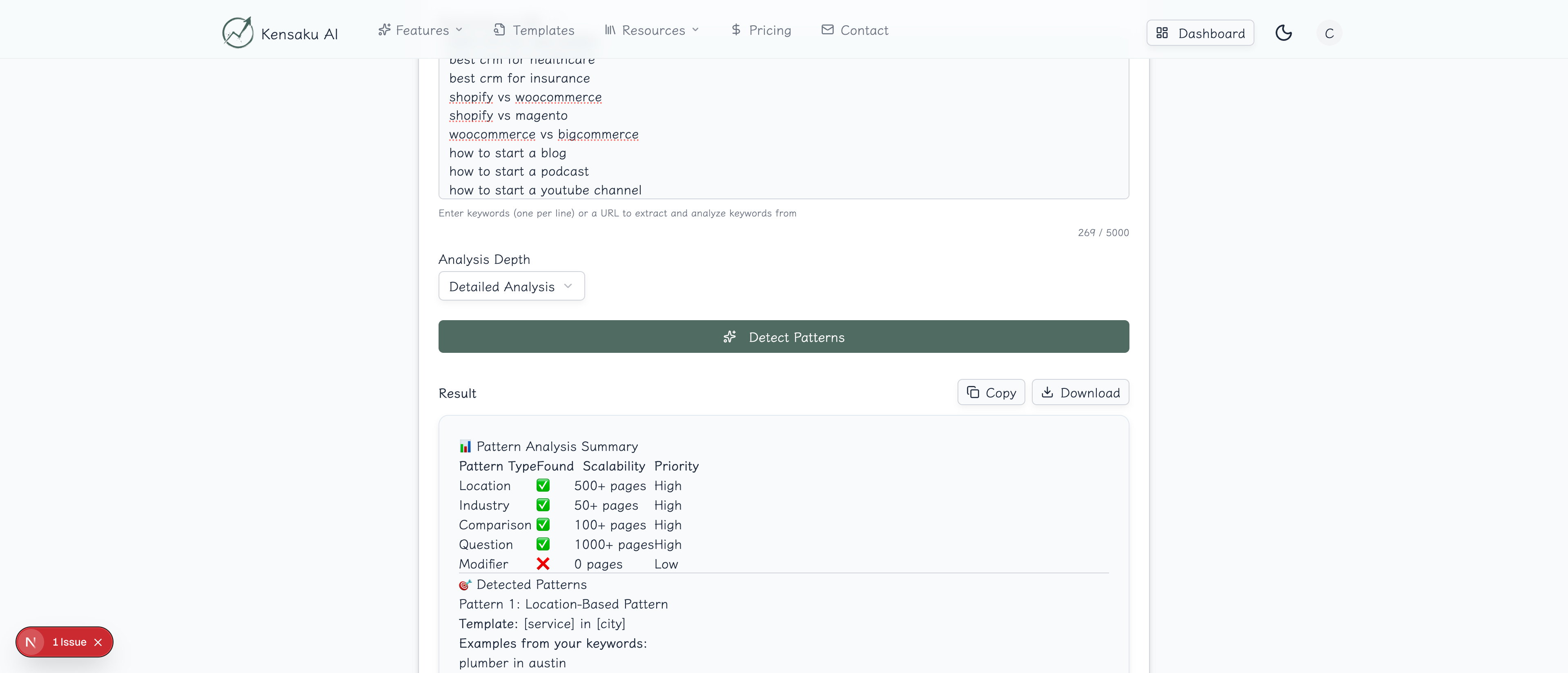
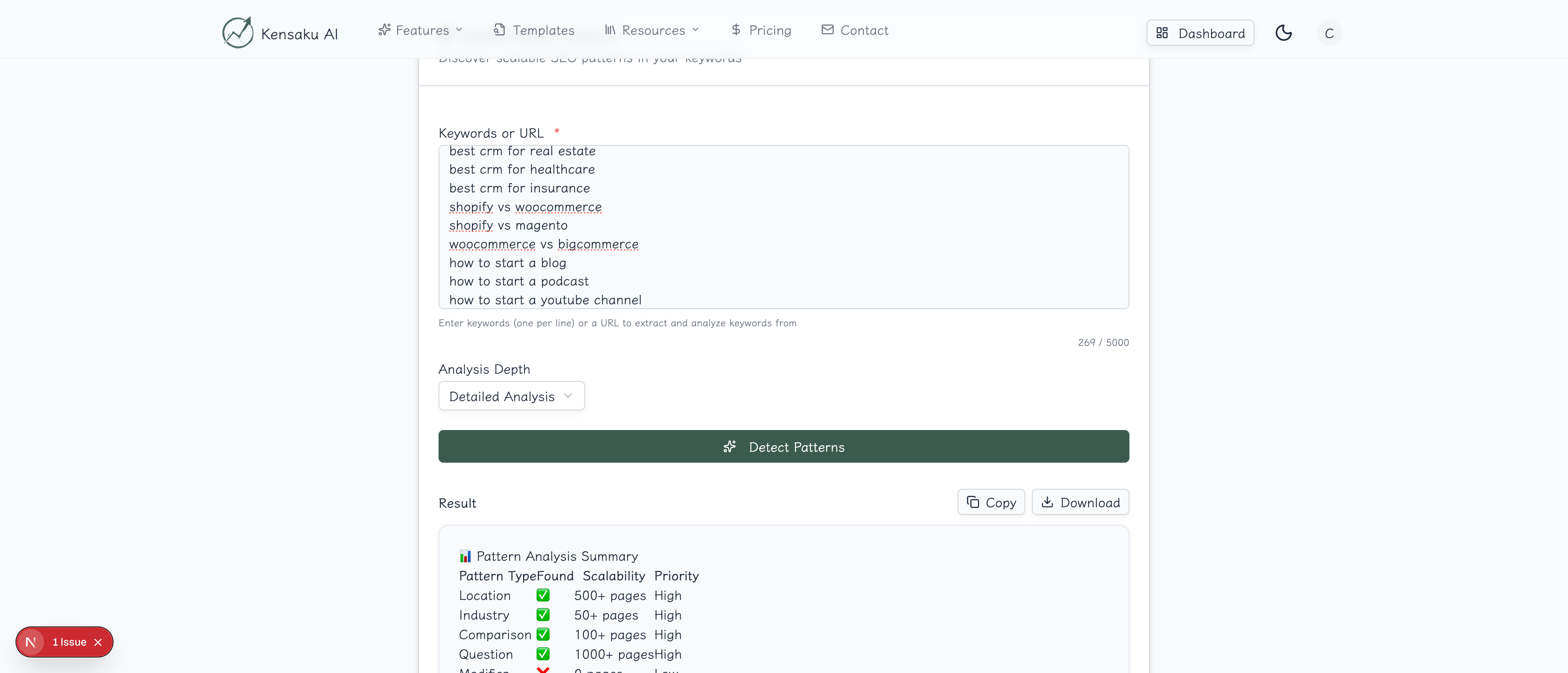
We tested the tool with a diverse set of keywords:
plumber in austin
plumber in dallas
plumber in houston
best crm for real estate
best crm for healthcare
best crm for insurance
shopify vs woocommerce
shopify vs magento
woocommerce vs bigcommerce
how to start a blog
how to start a podcast
how to start a youtube channel
Results Summary
| Pattern Type | Found | Scalability | Priority |
|---|---|---|---|
| Location | Yes | 500+ pages | High |
| Industry | Yes | 50+ pages | High |
| Comparison | Yes | 100+ pages | High |
| Question | Yes | 1000+ pages | High |
Implementation Recommendations
The tool provided specific guidance:
Highest Priority: Create 50 location-specific landing pages for "plumber in [city]" targeting major US metros.
Quick Win: Build 10 comparison pages for "best crm for [industry]" targeting underserved verticals.
Long-term: Scale "how to" content hub with 200+ guides focusing on high-volume beginner tutorials.
Turning Patterns into Pages
Once you've identified patterns, the next steps are:
1. Validate the Opportunity
Before building hundreds of pages, validate with a small batch:
- Create 5-10 test pages
- Monitor indexing and rankings
- Measure traffic and conversions
- Refine your template based on results
2. Build Your Data Schema
Each pattern needs data to fill the variables:
- Location patterns need a city database
- Industry patterns need a verticals list
- Comparison patterns need a product database
3. Design Your Template
Create content templates that:
- Answer the specific query completely
- Include unique data for each variation
- Provide genuine value to visitors
- Guide users toward conversion
4. Scale Production
With validated templates and data, you can generate pages at scale using:
- Custom development
- CMS templates
- Kensaku AI's programmatic SEO platform
Common Pattern Detection Mistakes
Ignoring Low-Volume Patterns
A pattern with 10 searches per keyword across 500 variations equals 5,000 monthly searches. Don't dismiss patterns just because individual keywords seem small.
Forcing Patterns That Don't Exist
Not every keyword list contains scalable patterns. If the AI doesn't detect patterns, your keywords might be too diverse or already optimized.
Skipping Validation
Just because a pattern exists doesn't mean it will work. Always validate with test pages before full-scale implementation.
Integrating with Other Tools
The Pattern Detector works best as part of a complete workflow:
- Keyword Research Tool → Generate initial keyword list
- Pattern Detector → Identify scalable patterns
- Location Expander → Expand location-based patterns
- Comparison Matrix Generator → Build comparison keyword matrices
Get Started
Ready to discover the patterns hiding in your keywords? Try our free Keyword Pattern Detector now.
For teams ready to implement programmatic SEO at scale, explore our full platform with AI-powered content generation, data enrichment, and WordPress integration.