Your title tag is the single most important on-page SEO element. It's what users see in search results, browser tabs, and social shares. A great title tag can mean the difference between ranking on page one and getting buried—and between getting clicks and getting ignored.
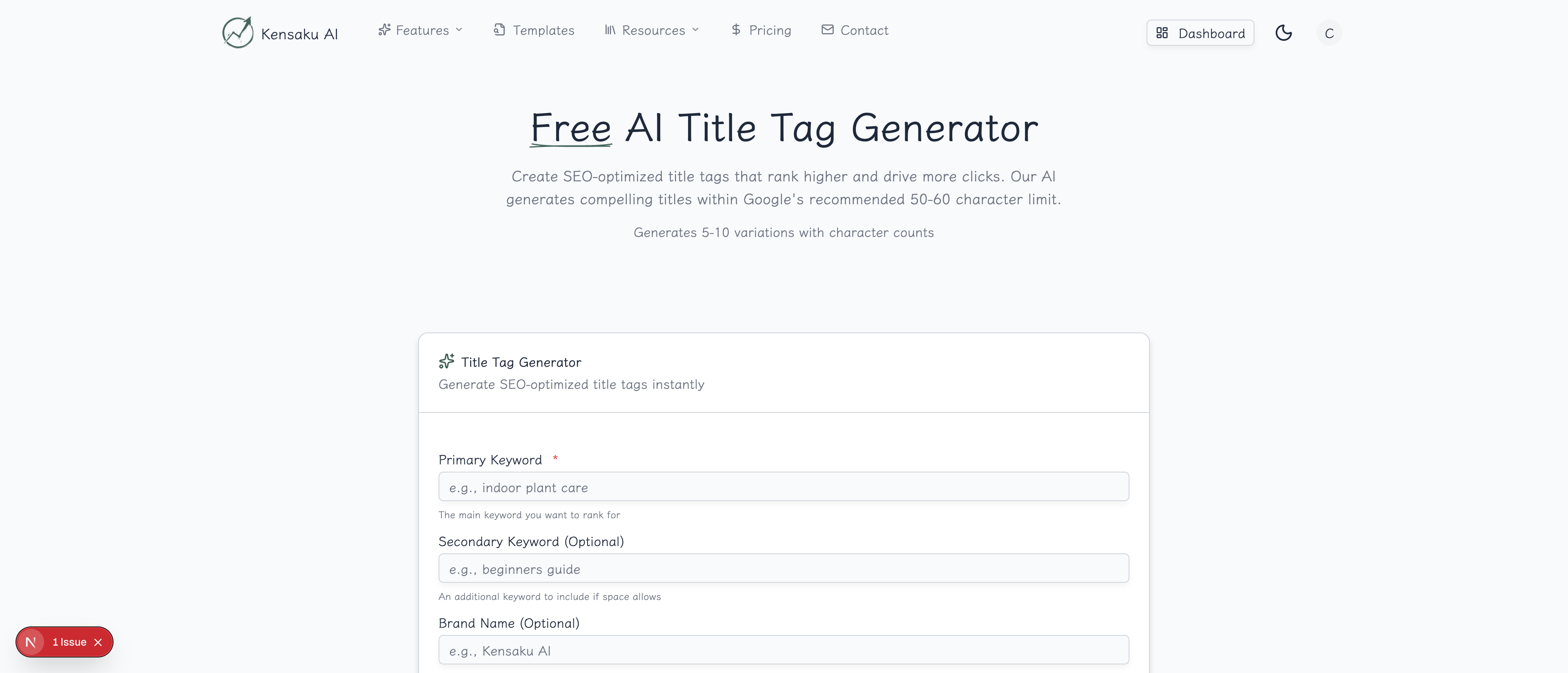
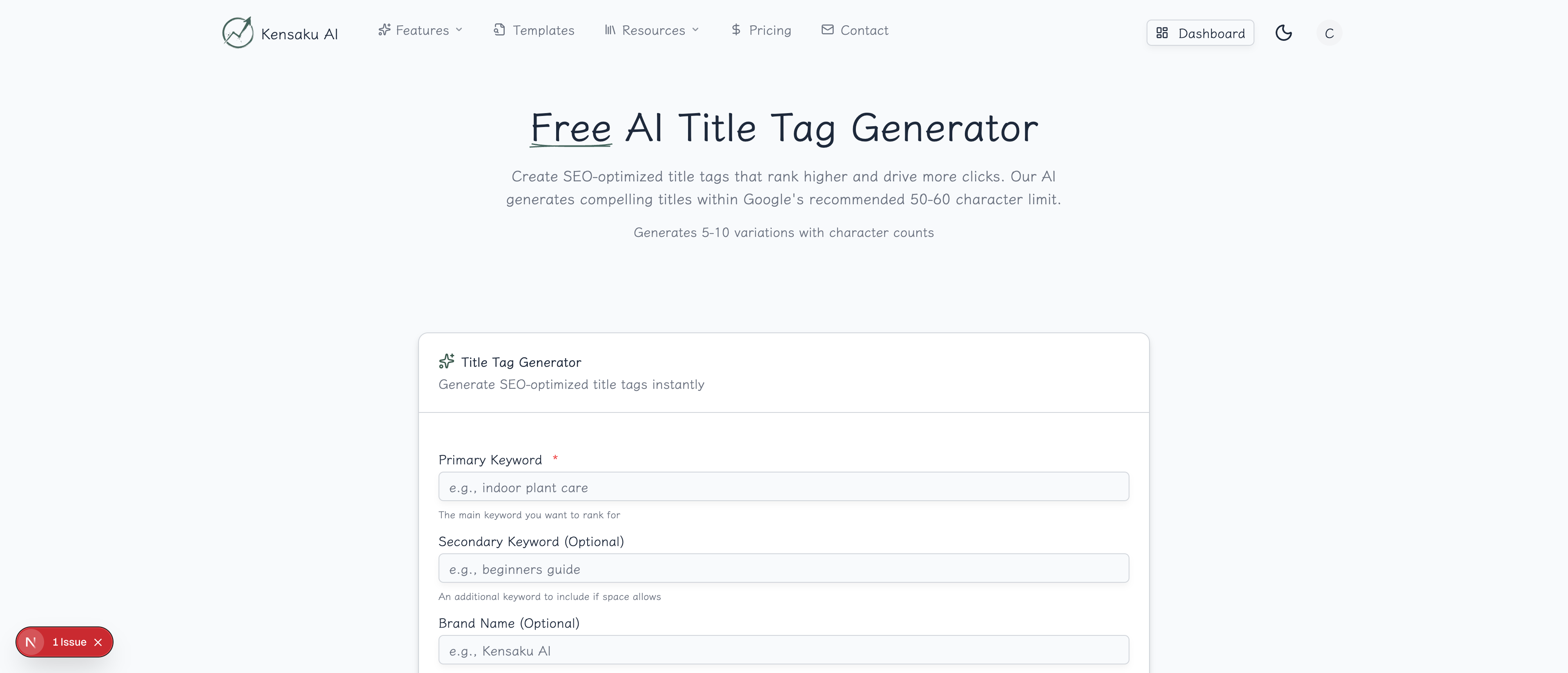
Our free AI Title Tag Generator creates optimized title tags that balance SEO best practices with click-worthy appeal, complete with character counting to avoid truncation.
What is a Title Tag?
The title tag is an HTML element that specifies the title of a web page. It appears in three key places:
- Search results: The clickable blue link in Google
- Browser tabs: The text shown in your browser's tab bar
- Social shares: Often used as the default share title
In HTML, it looks like:
<head>
  <title>Your Page Title | Brand Name</title>
</head>
Why Title Tags Matter for SEO
Direct Ranking Factor
Title tags are a confirmed Google ranking factor. Including your target keyword in the title signals relevance to search engines.
Click-Through Rate Impact
A compelling title dramatically affects whether users click your result:
| Title Quality | CTR Impact |
|---|---|
| Keyword-optimized + compelling | +50% CTR |
| Keyword-only, boring | Baseline |
| Missing keyword, vague | -30% CTR |
| Truncated or confusing | -40% CTR |
First Impression
Your title is often the first thing users see. It sets expectations and determines whether your content seems relevant to their search.
Brand Recognition
Including your brand name builds recognition and trust, especially for users who see you multiple times in search results.
How the Generator Works
Step 1: Enter Your Target Keyword
Provide the main keyword you want to rank for. This will be incorporated naturally into your title suggestions.
Good keywords:
- "programmatic SEO guide"
- "best CRM for small business"
- "how to start a podcast"
Too broad:
- "SEO"
- "software"
- "marketing"
Step 2: Describe Your Content
Give the AI context about what your page covers:
- What problem does it solve?
- Who is the target audience?
- What makes your content unique?
- What type of content is it (guide, list, review, etc.)?
Step 3: Add Your Brand Name (Optional)
Include your brand if you want it appended to titles. Common formats:
Title | Brand NameTitle - Brand NameBrand Name: Title
Step 4: Select Content Type
Choose your content format for appropriate title styles:
- Blog Post: Informational, how-to focused
- Product Page: Commercial, feature-focused
- Landing Page: Conversion-focused, benefit-driven
- Category Page: Broad, navigational
- Comparison: vs. format, decision-focused
Step 5: Generate and Choose
Click "Generate" to receive multiple title options. Each includes:
- Character count
- Truncation warning if too long
- Power word highlights
- Keyword placement indicator
Title Tag Best Practices
Optimal Length
| Guideline | Characters |
|---|---|
| Safe for all devices | Under 55 |
| Optimal range | 50-60 |
| Risk of truncation | 60-70 |
| Will be truncated | Over 70 |
Google measures by pixel width, not characters. Wide characters (W, M) use more space than narrow ones (i, l).
Keyword Placement
Front-load your target keyword when possible:
Better: "Programmatic SEO: The Complete Guide for 2025" Worse: "The Complete Guide for 2025 on Programmatic SEO"
Early keyword placement:
- Signals immediate relevance
- Survives truncation
- Catches the eye faster
Power Words
Include words that drive clicks:
- Urgency: Now, Today, 2025
- Value: Free, Ultimate, Complete
- Numbers: 10 Tips, 5 Steps, 50% Off
- Exclusivity: Secret, Insider, Proven
- Emotion: Amazing, Essential, Powerful
Brand Placement
Where to put your brand:
| Scenario | Recommendation |
|---|---|
| Well-known brand | End of title |
| Building brand awareness | End of title |
| Brand is the keyword | Beginning |
| Limited space | Omit brand |
Avoid Common Mistakes
- Keyword stuffing: "SEO Tips SEO Guide SEO Strategies"
- All caps: "THE BEST SEO GUIDE EVER"
- Clickbait without substance: "You Won't Believe..."
- Duplicate titles: Same title on multiple pages
- Missing keywords: Generic titles without target terms
Title Tag Formulas That Work
The How-To
How to [Achieve Goal] [Qualifier]
Examples:
- "How to Start a Podcast in 2025 (Step-by-Step Guide)"
- "How to Rank on Google Without Backlinks"
The Listicle
[Number] [Adjective] [Keyword] [Promise]
Examples:
- "15 Proven SEO Strategies That Actually Work"
- "7 Simple Ways to Increase Website Traffic"
The Ultimate Guide
[Keyword]: The [Ultimate/Complete/Definitive] Guide
Examples:
- "Programmatic SEO: The Complete Guide for Beginners"
- "Content Marketing: The Ultimate Strategy Guide"
The Comparison
[Option A] vs [Option B]: [Resolution]
Examples:
- "Shopify vs WooCommerce: Which Is Better in 2025?"
- "SEMrush vs Ahrefs: The Definitive Comparison"
The Question
[Question About Pain Point]?
Examples:
- "Why Isn't Your Website Ranking? (And How to Fix It)"
- "What Is Programmatic SEO and Should You Use It?"
The Best Of
Best [Category] for [Use Case/Year]
Examples:
- "Best SEO Tools for Small Businesses (2025)"
- "Best CRM Software for Real Estate Agents"
Programmatic SEO Title Tags
Template-Based Approach
For thousands of pages, create title templates with variables:
Template: "Best [Product] for [Industry] | Compare & Reviews"

Generates:
- Best CRM for Real Estate | Compare & Reviews
- Best CRM for Healthcare | Compare & Reviews
- Best CRM for Insurance | Compare & Reviews
Variable Length Considerations
Test templates with longest/shortest variables:
Template: "[City] [Service] - Get Free Quotes | Brand"

Test cases:
- "Austin Plumbing - Get Free Quotes | Brand" (43 chars) ✓
- "San Francisco Air Conditioning Repair - Get Free Quotes | Brand" (65 chars) ⚠️
Maintaining Uniqueness
Even with templates, ensure titles are meaningfully different:
Too similar:
- "CRM Software for Industry A"
- "CRM Software for Industry B"
Better:
- "Best CRM for Real Estate: Manage Leads & Close Deals"
- "Healthcare CRM Software: HIPAA Compliant Solutions"
Quality at Scale
For programmatic SEO pages:
- Validate all generated titles against character limits
- Check for accidental duplicates
- Ensure keyword variations are natural
- Monitor CTR across title patterns
Measuring Title Tag Performance
Search Console Data
Track in Google Search Console:
- Average position: Are you ranking?
- Impressions: Are you appearing in results?
- CTR: Are people clicking?
A/B Testing Titles
Test different title approaches:
- Record baseline CTR for 2-4 weeks
- Change title tag
- Wait 2-4 weeks for data
- Compare CTR changes
- Keep winner, iterate
What to Test
- Number inclusion vs. no number
- Question vs. statement format
- Brand included vs. omitted
- Power words vs. straightforward
- Length variations
Common Title Tag Questions
Does Google Rewrite Titles?
Yes, Google sometimes generates its own titles if:
- Your title doesn't match search intent
- It's too long or too short
- It's keyword-stuffed
- It's duplicate content
- The H1 seems more relevant
Write good titles to minimize rewrites.
Should Every Page Have a Unique Title?
Yes. Duplicate titles:
- Confuse search engines
- Split ranking potential
- Provide poor user experience
- May trigger manual review
How Often Should I Update Titles?
Update titles when:
- CTR is significantly below average
- Rankings have dropped
- Content has been substantially updated
- Targeting different keywords
- Testing new approaches
Title Tag vs. H1
| Element | Purpose |
|---|---|
| Title tag | Search results, browser tab, SEO |
| H1 | On-page headline for readers |
They can be similar but don't have to be identical. Titles are often shorter and more keyword-focused.
Integration with Content Workflow
Build title optimization into your process:
- Keyword Research → Identify target keyword
- Content Brief → Define content angle
- Title Tag Generator → Create optimized title
- SERP Preview → Check search appearance
- Headline Analyzer → Verify click appeal
- Publish and Monitor → Track performance
Get Started
Ready to create title tags that rank and get clicks? Try our free AI Title Tag Generator now.
For teams creating content at scale with programmatic SEO tools, explore our full platform with bulk title generation and optimization across thousands of pages.