If you've ever wondered how some websites seem to dominate search results across thousands of related keywords, the answer is often programmatic SEO. This approach to content creation has become the secret weapon for businesses looking to scale their organic traffic without scaling their content teams proportionally. Tools like a programmatic SEO platform make this accessible to teams of any size.
The Results Speak for Themselves
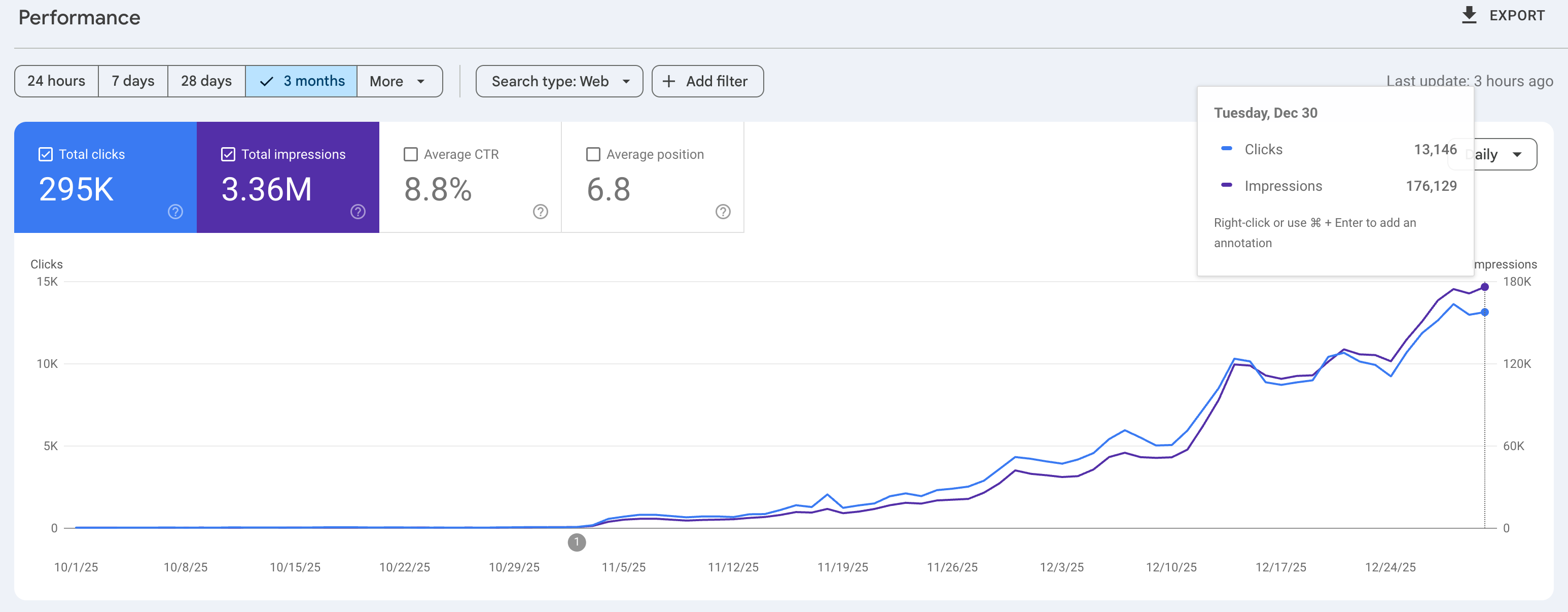
Let's look at real data. The graph below shows the organic growth achieved through a programmatic SEO strategy over just three months:
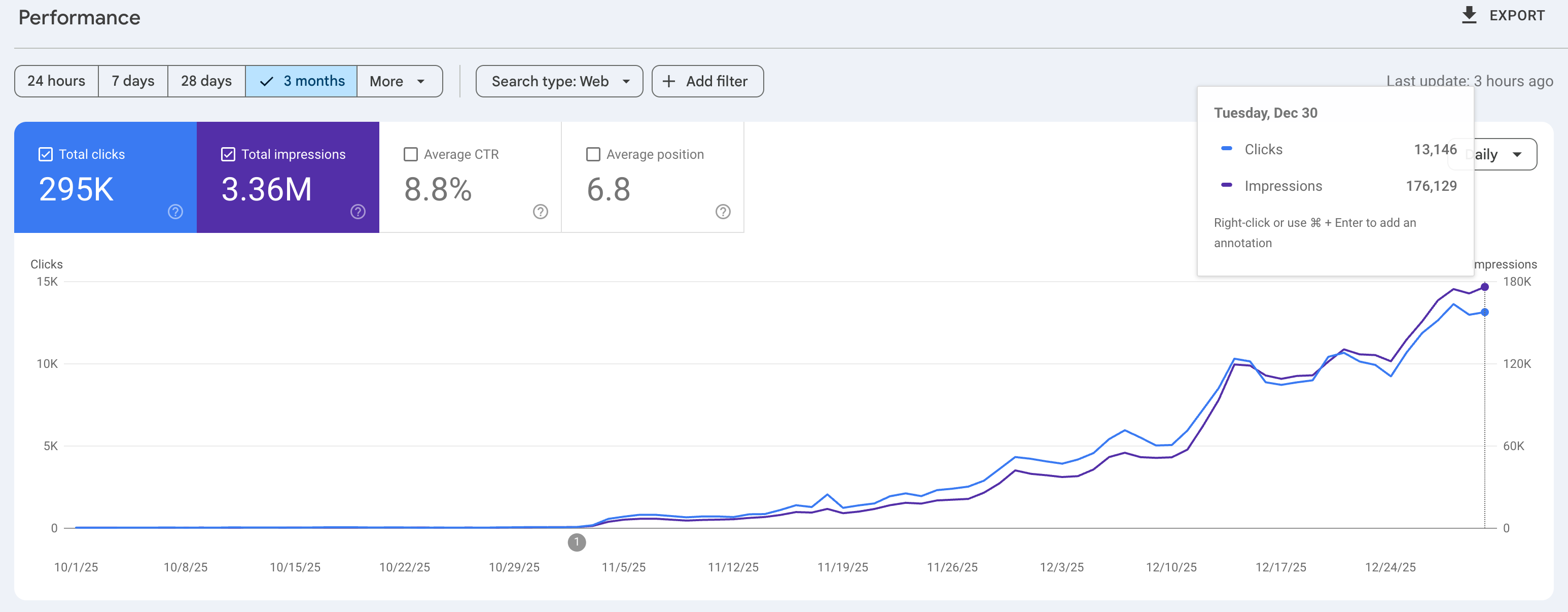
The numbers are compelling:
- 295,000 total clicks in 3 months
- 3.36 million impressions
- 8.8% average CTR (well above industry averages)
- 6.8 average position across all tracked keywords
Notice the exponential growth curve—this is the signature pattern of successful programmatic SEO. Once your pages start ranking, the compound effect kicks in, and traffic accelerates.
Why Traditional SEO Can't Keep Up
Traditional content marketing follows a linear model: one writer produces one article targeting one keyword cluster. Even with a full content team, you're limited to perhaps 10-20 quality pieces per month.
But what if your market has:
- 500 cities you could target?
- 200 product comparisons you could make?
- 50 industries you could serve?
That's 750+ pages of potential content. At a traditional pace, you're looking at years of work—time your competitors won't give you.
The Math Problem with Manual Content
| Approach | Pages/Month | Time to 750 Pages | Cost (at $200/page) |
|---|---|---|---|
| Traditional | 10 | 75 months | $150,000 |
| Programmatic | 100+ | 7 months | $15,000-30,000 |
Programmatic SEO doesn't just save time—it fundamentally changes the economics of content marketing.
Five Reasons to Use Programmatic SEO
1. Capture Long-Tail Keywords at Scale
Long-tail keywords (specific, lower-volume searches) convert better than head terms. Someone searching "best CRM for real estate agents in Texas" has much clearer intent than someone searching "CRM software."
Programmatic SEO lets you create pages for every variation: every location, every industry, every use case. You capture the entire long tail, not just the head.
2. Compound Growth Over Time
Look again at that traffic chart. The growth isn't linear—it's exponential. Here's why:
- Month 1: Pages get indexed, start appearing in results
- Month 2: Early rankings improve as engagement signals accumulate
- Month 3+: Top-performing pages boost domain authority, helping other pages rank faster
Each page you publish makes the next one easier to rank.
3. Outpace Competitors Who Can't Scale
Most businesses are stuck in the traditional content mindset. They see programmatic SEO as too technical or risky. This creates an opportunity.
While they debate whether to write 10 or 15 articles next quarter, you can deploy 500 pages targeting keywords they'll never reach.
4. Data-Driven Decision Making
Programmatic SEO forces you to think systematically about your market. You'll:
- Map out every keyword pattern in your space
- Build datasets that become competitive moats
- Test and iterate faster because you have more data points
The insights you gain inform not just SEO, but product development, sales messaging, and market positioning.
5. Lower Cost Per Acquisition
With traditional content, your cost per click is effectively the cost of creating that content divided by its lifetime traffic. A $500 article that gets 5,000 clicks costs $0.10/click.
Programmatic content at scale can achieve $0.01-0.03 per click—10x more efficient than traditional content and often 100x more efficient than paid advertising.
When Programmatic SEO Makes Sense
Programmatic SEO isn't right for every situation. It works best when:
- You have repeatable search patterns: "[Service] in [City]", "[Product A] vs [Product B]", "[Tool] for [Industry]"
- You can source unique data: Information that makes each page genuinely valuable
- Your market has sufficient search volume: The combined long-tail volume justifies the investment
- You can maintain quality at scale: Templates that produce genuinely helpful content
The Risk of NOT Using Programmatic SEO
Consider what happens if you don't adopt this approach:
- Competitors capture your long-tail traffic: They build the pages, they get the clicks
- You overpay for traffic: Forced to use paid ads for keywords you could rank for organically
- You miss market intelligence: Without comprehensive keyword coverage, you have blind spots in your market understanding
- Growth plateaus: Traditional content hits diminishing returns as you exhaust head terms
Getting Started
The path to 295K clicks per quarter isn't complicated, but it does require the right approach:
- Identify your patterns: What repeatable search queries exist in your market?
- Estimate the opportunity: What's the combined search volume? What traffic could you capture?
- Build your data: What information will make each page unique and valuable?
- Design your templates: How will you structure content to serve each query?
- Launch and optimize: Start small, measure results, scale what works
How Kensaku AI Accelerates This Process
Building a programmatic SEO engine from scratch requires significant technical resources. Kensaku AI's programmatic SEO wizard provides the infrastructure you need:
- Pattern Detection: AI-powered analysis identifies the highest-potential keyword patterns in your market
- Traffic Estimation: Get accurate projections before you invest in content creation
- Data Enrichment: Automatically enhance your datasets with AI-generated insights and research
- Bulk Content Generation: Create hundreds of unique, high-quality pages while maintaining editorial standards
- Performance Tracking: Monitor rankings, traffic, and conversions across your entire programmatic content portfolio
Conclusion
The question isn't whether programmatic SEO works—the data proves it does. The question is whether you'll be the one capturing that traffic, or watching your competitors do it.
295,000 clicks. 3.36 million impressions. Three months. That's the power of programmatic SEO done right.
Ready to scale your organic growth? Explore the programmatic SEO wizard or start your free trial to see what programmatic SEO can do for your business.